

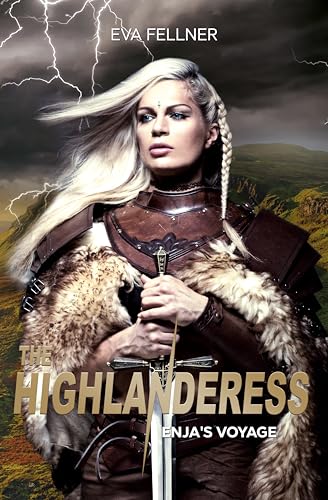
Enja was born to be a healer, but circumstances turned her into an assassin. Captured and carried far from home, Enja finds her native Scotland torn apart by the invading English. When Scottish clan leader James Douglas saves her life, Enja soon finds herself wrapped up in conspiracies and battle plans.
Can she save her home and the man she loves, or will she become his next target?
The Highlanderess is the first entry in a five-book, historical romance series perfect for fans of Outlander. Check out an excerpt of the book below!
____________________

____________________
The Highlanderess
Chapter 1
Scotland in May 1307
What the devil has gotten into me lately to stumble upon such a mess? I couldn’t shake that thought all day long. The heavy dress stuck to my body, wet with sweat, the chest and waist laced so tightly there was only room for shallow breaths. The tight collar threatened to suffocate me, and the brocade bodice rubbed uncomfortably against my ribs. It’s your own fault, I thought. You probably want to prove yourself to everyone again, Enja. The bridesmaids had placed the bridal wreath on the white silk as a sign of my chastity. Under the veil that covered my face, I grimaced at the thought of my own folly.
I scanned the ranks of the bystanders as I walked slowly down the aisle. Nobody suspected anything — they expected the face of Elisabeth Armstrong, the beautiful daughter of the powerful clan laird, Alexander Malcolm Armstrong. In size and hair colour, Elisabeth and I hardly differed, but otherwise we were as different as day and night.
Durham Cathedral was overcrowded. The English families looked at me with a mixture of boredom and disgust. If only they knew. With painfully slow steps, I moved to the altar on the arm of the old laird.
“Slowly,” the aged lady’s maid had drummed into me. “Slowly.”
I put one foot in front of the other, careful not to stumble over the hem of the dress — much too long — that they had forced me into. I felt ridiculous. The maid had assured me that in this dress I could fool even the old laird himself. Laird Armstrong had resolutely put the plaid with the Armstrong clan colours around me and fastened it with his wife’s silver brooch. None of the English guests had ever seen his daughter, and all the Armstrongs knew exactly what was about to transpire.
The tailor had ensured my arms, hands, and neck were covered to my chin — cleverly concealing my fair skin and strong muscles. Underneath I wore black trousers so I could shed the bridal dress if necessary. The heat and tightness made me feel like a tethered beast. The laird beside me held my hand and, with a grave expression, nodded.
It had been his idea to escort me to the altar in place of his daughter, so as not to marry her off to the English baron Henry de Keighley. For this, he risked the enmity of the English king — not to mention his life. I had been chosen as the most suited for this daring deception; for me, it was also a matter of personal vengeance against King Edward. In the battle against the despised English, all means were right and proper.
The plan to assassinate the baron at his own wedding was brazen, but possible. Edward I, weakened by illness, had been shrewdly wedding the women of Scottish nobility to English barons to bind the difficult-to-control clans. Refusal meant death for high treason. The Armstrong clan — battle-hardened, proud, and seated between Cumberland and the Scottish border — had been outraged to learn that Alexander’s only daughter was to be a pawn in this gruesome game. His protests fell on deaf ears.
We reached the altar. Henry de Keighley was already there, looking at us expectantly. Not a bad-looking man, I noticed briefly — but unfortunately, he was English. Politics required sacrifices; that had been the motto of my Grandmaster, the assassin leader Hassan I-Shabbah. I couldn’t suppress a smile. With my free hand I felt for the dagger, hidden in a fold of the dress. How good it was to feel the cold steel under my fingers. My heart steadied. What a mockery of fate that no one would think to search the bride for weapons.
The young Baron de Keighley bowed courteously as I approached, took my hand from the laird’s arm, and kissed it. He carefully helped me straighten my dress so I could kneel at the bench provided. I had practised this a hundred times. I heard nothing of the ceremony. My glances kept sliding to the wooden choir stalls, to the altar, to the stone pillars on either side. Bishop Antony Brek’s monotonous phrases interested me as little as the sentences dutifully repeated by my groom — his voice far too high for his appearance. Without really thinking, I repeated the phrases when required. I waited, impatiently, for the moment Henry would raise my veil to kiss me. That was when he would be vulnerable. That was when I would strike.
I took a deep breath. The bishop’s voice rang out one final time. Then the voices of the congregation.
“You may kiss the bride!”
I turned toward the man beside me. He raised both hands to lift the veil, pulling it carefully up over my face. Bafflement — that was the first thing I saw in his eyes, as they moved from my mouth to my forehead, to the small tattoo of the cross above. Surprise. Only when it turned to a grimace did I know my dagger had not missed its aim. I had stabbed him above the fifth rib, near his breastplate, directly in the heart. He died instantly. Suddenly, all hell broke loose in Durham Cathedral.
***
The self-appointed Scottish King Robert de Bruce seemed weaker than ever in those days, hiding in the far north to avoid English troops. Edward the First assembled his forces once more to deliver a final blow to the Scottish resistance. The people in the borderlands had little peace, their region prey to robber-knights of both nations. Into this desperate world, clan chief Alexander Malcolm Armstrong had turned to Enja — an assassin from the Orient who had made a living legend of herself in the Scottish Highlands, spoken of by the bards in the same breath as William Wallace and James Douglas.
Lady Enja von Caerlaverock could never have imagined how that fateful wedding in Durham Cathedral would alter the course of her life. On May 7, 1307, she unwittingly penned a new chapter in the saga of the Scottish bards.
Berwick, a few days later
The inn in the tranquil town of Berwick was bustling that evening. Berwick-upon-Tweed, in the contested borderlands, had long been a flashpoint between Scots and English. The Scottish bard Alistair MacMhuirich sat comfortably in a corner of the spacious dining room, having eaten the dish of the day — stew with vegetables, barley meal, and wild boar bacon. He brushed the leftover food from his greying beard, belched contentedly, and ordered a second beaker of Uisge beatha. He had already drawn attention by announcing outrageous reports from Durham. In no time the landlord and guests had invited the educated storyteller to eat and drink, eager for the latest news.
“Worthy ladies and highly esteemed gentlemen,” he began, in the ritual way that had served as the Highlands’ evening entertainment for centuries. Even fighting dogs fell silent to hear his words.
“A few days ago, the young Lady Elisabeth Armstrong, the only daughter of Alexander and Catherine Armstrong, and the Baron Henry de Keighley, Knight of Shire in Lancashire, were to marry.” He cleared his throat. “I was invited to the celebration as a bard. But the real Lady Elisabeth never showed up.”
He delighted in the perplexed faces around him. A laugh like a billy goat pealed from his mouth. “As it happened, the real Lady Elisabeth had been replaced — another woman walked to the bridegroom and married him before God and the Church!”
“In her place?” came the horrified shouts. “Then it wasn’t Lady Elisabeth who stabbed the baron?”
“But no!” confirmed the bard. “On the way to the wedding, the carriage was stopped and the rebel Enja von Caerlaverock exchanged places with the bride, who was returned home unharmed. Lady Enja, who has taught the English what fear is in many battles, walked to the altar in Elisabeth’s place — and stabbed the bridegroom on the spot.”
“How could this woman get so close to the groom? Surely he must have seen it was not his bride?”
“Not even the bride’s father knew,” said the bard, straight-faced. “The king determines marriages on paper. Spouses see each other only on the wedding day. And the bride wore a veil that hid her face — which also hid the black cross between her eyes, the mark Lady Enja has borne since childhood.”
“A cross? In the middle of her forehead? How cruelly disfigured must this woman be?”
“I can assure you,” Alistair replied, “this woman wears her mark with such pride that it simply forbids that assumption. In any case, the bridegroom had no chance. The moment he lifted the veil to kiss her, her dagger struck him in the heart.”
He let the outbreak of female indignation subside before continuing.
“I was standing at the back with the Scottish family. Suddenly, burning bales of hay fell through the open side windows — damp, they smouldered more than burned, filling the church with thick smoke. You can imagine the panic. In the midst of the melee, the murderess dragged the bishop with her. Despite the billows of smoke, I could clearly see the woman before the high altar, saying goodbye to the priest with a slight bow. I knew then it was her. Enja von Caerlaverock.”
He leaned forward, his voice hushed. “She looked proudly in my direction and raised her hand. Then, without haste, she slipped out of the wedding dress — beneath it she wore men’s clothing — and placed the dress carefully on the altar. She put the dagger in her boot and swiftly climbed the ornate high altar.” He pointed upward, and all eyes followed. “I’ve never seen a person, let alone a woman, soar nine yards so quickly. Up the stone pillars to the window, she swung through it like a cat, under the angry roar of the English, and was gone.”
“She escaped?” squeaked the fat cook.
“She had accomplices outside — a hay cart positioned beneath the altar window. She jumped onto it and hid in the hay. The cart left the church grounds unobtrusively, and the perplexed guests were at a loss. Neither Scots nor English found her tracks. She had vanished into thin air, along with the hay wagon pulled by a black stallion — black as the night, with eyes that could see into the souls of every sinner.”
A shudder seized the room. Only the crackling of the logs and the sighing of the women could be heard as Alistair MacMhuirich sat back and turned his cap upside-down on the table. This was his story — at least, the one meant to reach the ears of the English king. The old laird had paid him handsomely for it.
“Edward will have you quartered as a traitor!” he had warned that madwoman from Caerlaverock at Hermitage Castle.
“He’s already tried, Alistair,” she had replied with a laugh. “And he won’t succeed this time either. Those who challenge the devil will reap death.”
Her eyes had sparkled like ice crystals as she spoke. How could he ever forget her…
Featured image: Connor Mollison / Unsplash


